Graffiti Removal on Glass & Plexiglass | GraffitiMobile
Graffiti removal on glass & plexiglass · Greater Montreal

Graffiti on glass? First, let’s identify what is actually affected.

GraffitiMobile assessesgraffiti removal on glass, storefronts, glass doors, plexiglass and acrylic for businesses, buildings, condominiums and managed properties. Glass, film, plexiglass and physical scratches do not require the same response.

Send my photos
Address + photos are enough.
No phone call required to get started.
Glass Commercial storefront Plexiglass / acrylic Films & coatings
Graffiti sur glass ou plexiglass - GraffitiMobile
GraffitiMobile · Glass & plexiglass
Transparent surface The first step is to distinguish what is deposited on the surface from what has actually scratched, etched or damaged a layer.
To get started 3 photos
Full view of the storefront
Close-up of the marking
Angled photo + panel edge
TO GET STARTED Address + photos You do not need to know whether it is glass or plexiglass before sending the request.
GLASS Hard and non-porous Pigment often remains on the surface, but films, etching and scratches change the assessment.
PLEXIGLASS More sensitive to scratches An acrylic surface can dull or develop micro-scratches more easily than glass.
FILMS A separate layer A tinted or protective film may be the layer that is actually affected.
Send the graffiti · glass & plexiglass

Send the surface. We’ll identify which layer is affected.

The goal is not to make you determine whether it is glass, acrylic, film or an actual scratch. Good photos are enough to begin making that distinction.

Address + full viewTo understand the storefront, size, height and access.
Close-up of the markingTo distinguish paint, marker, residue, haze or visible physical damage.
Angle + panel edgeTo see reflections, scratches and signs of film or acrylic material.
GraffitiMobile · Glass & plexiglass

Send my photos

Start with what you have. More details can follow if the job requires them.


    Idéalement : une vue générale, un gros plan et une photo montrant la surface autour.


    Recommended photos: a full view, a close-up of the marking and an angled photo showing the edge of the glazing.
    Glass vs plexiglass

    They are both transparent. Their tolerance for treatment is not the same.

    The real question is not only “will the paint come off?” You also need to know what the surface can tolerate without becoming scratched, dull or damaged.

    01

    Verre

    A hard, non-porous surface. Many markings remain on the surface, but film, etching or scratches can completely change the job.

    Paint / markerOften deposited on the surface depending on the product.
    Tinted or protective filmCan be more fragile than the glass underneath.
    Etched / scratched graffitiThe surface itself has been physically altered.
    Frames & sealsSilicone, rubber and metal can impose their own limitations.
    02

    Plexiglass / acrylic

    A transparent material that is softer than glass. A micro-scratched, dulled or chemically affected area can become highly visible under light.

    ScratchesHigher risk of micro-scratches than with glass.
    Chemical compatibilitySome products can alter the appearance of acrylic.
    GlossA dull area becomes immediately visible by contrast.
    AgeingAn older or micro-cracked panel provides less working margin.
    What is actually on the surface

    Deposited graffiti and an etched surface are not the same problem.

    On a transparent surface, the removable residue needs to be distinguished from damage that has already physically altered the material or a film.

    01Spray paint

    A layer deposited on the surface; the approach depends on the glazing and adjacent materials.

    02Marker / ink

    Can leave haze or traces depending on the product, film and transparent material.

    03Sticker & adhesive

    The main issue becomes the adhesive, whose removal must remain compatible with the surface.

    04Scratch / etching

    The material itself is altered; cleaning cannot recreate what has been scratched or etched away.

    05Damaged film

    The damaged layer may be the film rather than the glass or plexiglass underneath.

    Films, tints & protection

    The visible surface may already be a multi-layer system.

    A solar film, tinted film, scratch-protection film or decorative coating may be the actual layer affected by the graffiti.

    Principle The goal is not to “remove the mark at any cost.” First, we need to know whether we are working on glass, acrylic, a film or damage already etched into the surface.
    Tinted film

    It can be more sensitive than the glass and may be installed on only one side of the glazing.

    Protective film

    It may have been designed specifically to absorb wear or scratches instead of the glazing.

    Decorative coating

    A frosted, printed or opaque finish that can be visually altered independently of the material underneath.

    Seals & frames

    Rubber, silicone, painted aluminum and other materials also need to remain compatible with the service.

    Commercial applications

    The storefront is often the most visible surface of a business.

    On a storefront, a small marking can be more disruptive than large graffiti on a secondary wall. Transparency, reflections and proximity to customers make every defect more visible.

    01Commercial storefrontsRetail · restaurants · offices
    02Glass doorsMain entrances · access points
    03Protective plexiglassPanels · screens · barriers
    04Partitions & displaysCommercial · institutional
    Property management

    Multiple storefronts or multiple locations?

    A property can combine glass, metal, brick and concrete. Requests can remain centralized under the same service contact.

    Send my photos
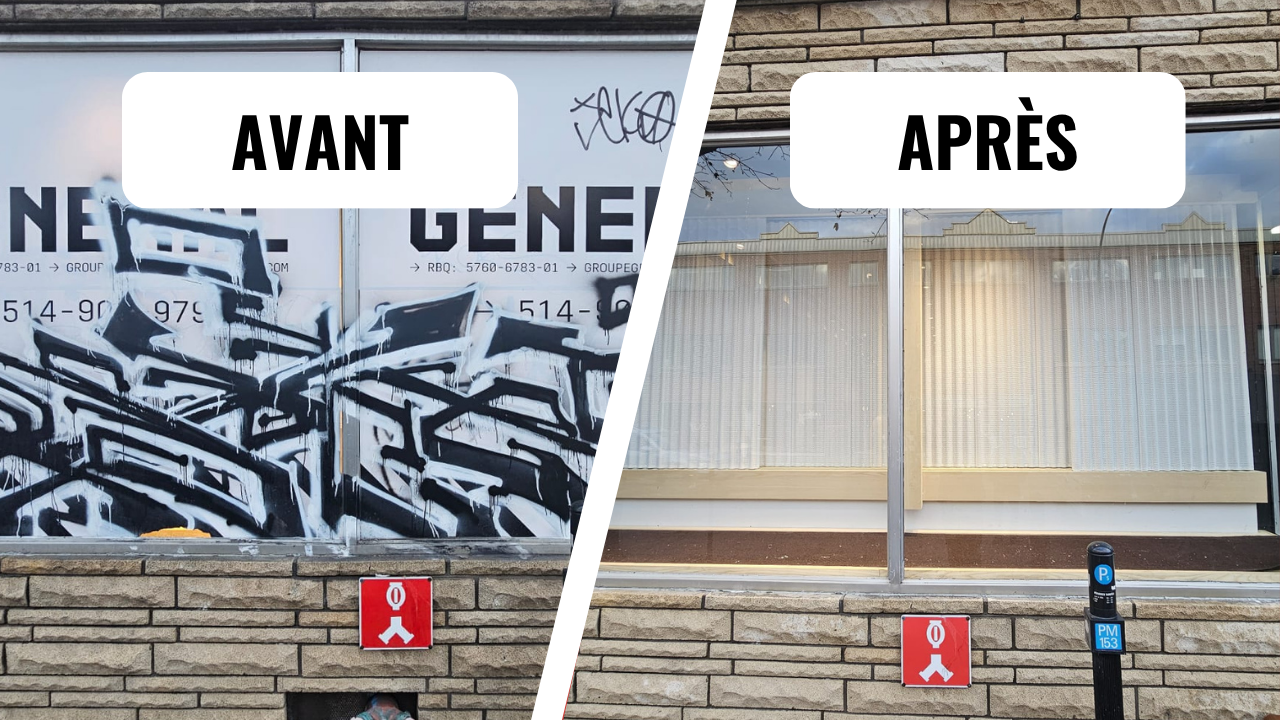
    Graffiti sur une devanture commerciale
    Context image · commercial property
    Storefront / business On a transparent surface, customers see the graffiti, reflections and the quality of the surface after service.
    The result and transparency

    On a transparent surface, a new scratch can be worse than the original mark.

    The result is not judged only by whether the pigment disappears. Transparency, gloss, films and materials around the glazing also need to be preserved.

    Plexiglass develops micro-scratches more easily

    A method that is acceptable on glass may be unsuitable for an acrylic surface.

    Etching is not a stain

    If the material is physically scratched or etched, simple cleaning cannot restore the surface to new condition.

    The film may be the layer that is actually damaged

    The glazing underneath may sometimes be intact while a film is marked or scratched.

    Frames and seals remain within the work area

    Silicone, rubber and painted metal can be more sensitive than the glass itself.

    FAQ · glass & plexiglass

    Frequently asked questions before sending photos.

    Can graffiti be removed from glass?
    Yes, in many situations. The result depends on the type of marking, whether a film is present and the condition of the glazing.
    Is plexiglass cleaned the same way as glass?
    No. Plexiglass or acrylic is softer and more sensitive to scratches and certain products. It needs to be identified before service.
    Can you remove permanent marker from a storefront?
    In many cases, yes, but the surface first needs to be identified and checked for film or surface treatment.
    What if the graffiti is etched or scratched into the glass?
    A scratch or etching is physical damage to the surface. Cleaning can remove residue, but it cannot recreate material that has been removed or scratched.
    Can graffiti be removed from tinted glass?
    It depends on the location and type of film. A tinted film can be more sensitive than the glass and needs to be identified before service.
    Are stickers and adhesive residue treated the same way?
    No. In this case, the main issue is the adhesive. The product and method need to remain compatible with the glass, plexiglass or film present.
    Can you work on a plexiglass door or acrylic panel?
    Yes, depending on the condition of the surface and the type of marking. Abrasive or overly aggressive methods can make an area duller or more scratched.
    Can you begin the assessment from photos?
    In many cases, yes. A full view, close-up, angled photo and photo of the panel edge can help distinguish the material and type of damage.
    How much does graffiti removal from glass or plexiglass cost?
    The price depends on factors such as size, type of marking, material, access, possible films and surface condition.
    Can you handle multiple storefronts or multiple properties?
    Yes. GraffitiMobile can assess a one-time job or requests from multiple properties within the service area.

    📞 Urgence 24/7 📸 Envoyer photos